
Make Learning Easy with Practical Methods That Actually Work
A Student-Friendly Guide to Learning Smarter, Growing Faster, and Unlocking Your True Potential
Learning is one of the most valuable skills you will ever develop. It shapes your knowledge, influences your decisions, and opens doors to opportunities that once seemed impossible. Yet, many students believe learning is difficult because they associate it with long study hours, endless textbooks, and the pressure of examinations.
The truth is different.
Learning does not have to be stressful. It becomes easier when you understand how your brain learns instead of simply forcing yourself to memorize information. The most successful students are not always the ones with extraordinary intelligence—they are the ones who have discovered practical methods that make learning more enjoyable, effective, and meaningful.
Think about a child learning to ride a bicycle. Reading a hundred pages about cycling will never teach balance. The real learning begins when the child starts pedaling, falls a few times, learns from mistakes, and keeps trying until riding becomes natural. Academic learning works in exactly the same way. Real understanding comes from practice, curiosity, and consistent effort.
If you have ever wondered why some people seem to learn quickly while others struggle despite working hard, this guide is for you. In this article, you will discover practical learning techniques that can improve your understanding, strengthen your memory, and help you become a confident lifelong learner.
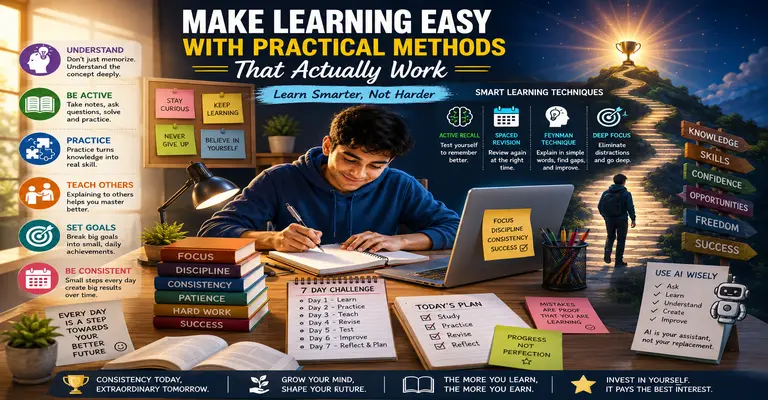
Why Does Learning Feel Difficult?
Many students think they are poor learners simply because they forget what they studied. In reality, the problem is rarely intelligence. It is usually the learning method.
Modern students face challenges that previous generations rarely experienced. Smartphones, social media, endless notifications, online entertainment, and information overload constantly compete for attention. Instead of focusing on one concept deeply, many students switch between multiple tasks every few minutes.
Imagine trying to fill a bucket with water while several holes remain open at the bottom. No matter how much water you pour, the bucket never fills. Similarly, if your attention is scattered, your brain cannot store information effectively.
Learning becomes easier when you reduce distractions and allow your mind to focus on one task at a time.
Success Begins with Understanding, Not Memorization
One of the biggest mistakes students make is trying to memorize everything without understanding it.
Memorization may help you pass tomorrow’s quiz, but understanding helps you remember information for years.
For example, imagine learning about gravity. You could memorize the definition exactly as written in your textbook. However, if you observe an apple falling from a tree or notice how objects always move toward the ground, you begin to understand the concept naturally.
Whenever you study something new, ask yourself:
- Why does this happen?
- How does it work?
- Where can I see this in real life?
- How can I explain it to someone else?
These simple questions transform passive reading into active thinking.
Develop Curiosity Before Opening the Book
Curiosity is one of the strongest learning tools.
Instead of studying because someone tells you to, study because you genuinely want to discover something new.
Suppose you are learning about Artificial Intelligence. Rather than immediately reading technical definitions, ask questions like:
- How does my smartphone recognize my face?
- Why does YouTube recommend videos I like?
- How do virtual assistants answer questions?
Once curiosity develops, your brain naturally searches for answers. Learning becomes an exciting journey instead of a boring responsibility.
Successful learners remain curious throughout their lives.
Learn Actively Instead of Reading Passively
Many students spend hours reading textbooks but remember very little afterward.
Why?
Because reading alone is a passive activity.
Active learning keeps your brain involved throughout the learning process.
Instead of simply reading, try these activities:
- Write notes in your own words.
- Draw diagrams or mind maps.
- Solve practice questions.
- Explain the topic aloud.
- Create examples from daily life.
- Teach a friend.
For instance, if you are learning programming, don’t just watch tutorials. Write code yourself. Make mistakes. Fix errors. Build small projects.
The more actively you participate, the stronger your understanding becomes.
Teach Others to Learn Better
When you explain a concept to someone else, you quickly discover whether you truly understand it.
Imagine explaining photosynthesis to your younger sibling or showing a friend how to solve a mathematics problem.
If you struggle to explain it clearly, your understanding still has gaps.
Teaching forces your brain to organize information logically, making it much easier to remember.
Remember this simple idea:
“If you cannot explain it simply, you probably haven’t understood it deeply enough.”

Improve Your Memory by Reviewing, Not Re-reading
One of the biggest misconceptions about learning is believing that reading the same chapter repeatedly will improve memory. While repetition has its place, simply re-reading information often creates a false sense of confidence. You may recognize the words on the page, but recognition is not the same as remembering.
A more effective approach is active recall.
After finishing a topic, close your book and try to write down everything you can remember. Don’t worry if you miss some details. Check your notes afterward, identify the gaps, and repeat the process.
This simple habit trains your brain to retrieve information instead of merely recognizing it. The more often you recall knowledge, the stronger those memories become.
Remember:
Learning happens when your brain works to remember—not when your eyes work to reread.
Use the Feynman Technique to Master Any Subject
The famous physicist Richard Feynman believed that true understanding comes from simplicity.
His learning method is incredibly practical and works for almost every subject.
Follow these four steps:
Step 1: Learn the topic.
Read the concept carefully and understand the basics.
Step 2: Explain it simply.
Pretend you’re teaching a 10-year-old child. Use everyday language instead of technical terms.
Step 3: Find the gaps.
Whenever you struggle to explain something, return to your study material and strengthen that area.
Step 4: Simplify again.
Repeat the process until your explanation becomes clear and easy to understand.
This technique builds deep understanding instead of temporary memorization.
Protect Your Focus
Concentration has become one of the most valuable skills in today’s digital world.
Every notification, message, or social media update interrupts your thinking. Even a short distraction can take several minutes to recover from.
When studying, create an environment that supports focus.
- Keep your phone away or switch it to silent mode.
- Study at a clean and organized desk.
- Work on one subject at a time.
- Take short breaks after focused sessions.
- Avoid multitasking.
Think of your attention as a flashlight. The more concentrated the beam, the brighter everything becomes.
Use Artificial Intelligence as a Learning Partner
Artificial Intelligence has changed education, but it should never replace your thinking.
Instead of asking AI to complete your assignments, use it to strengthen your understanding.
Good ways to use AI include:
- Asking for simple explanations.
- Practicing interview questions.
- Generating quizzes.
- Summarizing difficult topics.
- Finding different examples.
- Checking grammar and writing.
- Brainstorming project ideas.
Poor ways to use AI include:
- Copying assignments without understanding.
- Depending on AI for every answer.
- Avoiding independent thinking.
Remember:
AI can accelerate learning, but curiosity and effort still belong to you.
Build Skills, Not Just Marks
Examination scores are important, but they are not the only measure of success.
Today’s employers and universities value practical skills such as:
- Communication
- Critical thinking
- Creativity
- Problem-solving
- Leadership
- Teamwork
- Digital literacy
- Adaptability
Whenever you learn something new, ask yourself:
“How can I apply this knowledge in real life?”
Knowledge becomes valuable when it creates solutions.
Common Mistakes That Make Learning Harder
Many students unknowingly slow down their own progress.
Avoid these common mistakes:
- Studying only before exams.
- Reading without taking notes.
- Trying to memorize everything.
- Comparing yourself with others.
- Skipping practical exercises.
- Studying for long hours without breaks.
- Depending entirely on AI or online solutions.
- Giving up after making mistakes.
Instead, focus on progress rather than perfection.
Every expert was once a beginner.
Your Learning Journey Is Your Greatest Investment
Education is not just about earning a certificate—it is about becoming a better thinker, problem solver, and lifelong learner.
The world is changing rapidly. New technologies, careers, and opportunities emerge every year. The people who continue learning will always have an advantage over those who stop growing.
Never underestimate the power of consistent effort. You don’t need to be the smartest student in the classroom. You simply need the willingness to learn, practice, and improve every day.
Every chapter you read, every mistake you correct, every project you complete, and every question you ask brings you one step closer to the person you want to become.
Remember, success is rarely built overnight. It is built one lesson, one habit, and one decision at a time.
“Learning is not about filling your mind with information; it is about training your mind to think, create, and solve problems. The more you learn, the more capable you become of shaping your own future.”
Make learning your lifelong companion rather than a temporary task. Stay curious, ask questions, embrace challenges, and never stop improving yourself. The skills you build today will become the opportunities you enjoy tomorrow.
Start small. Stay consistent. Believe in your ability to grow.
Because the easiest way to change your future is to change the way you learn today.
Want to continue learning?
Register and get practical tutorials, tips, and real-world projects.
Register