
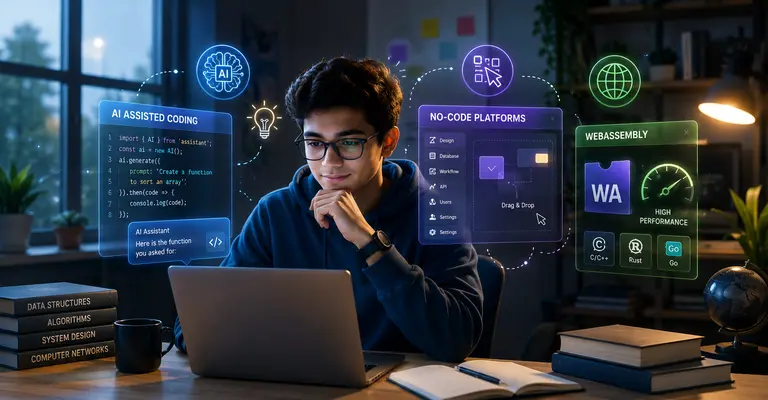

1. AI-Assisted Coding: Your New Programming Partner
What is AI-Assisted Coding?
AI-assisted coding uses artificial intelligence to help developers:
- Generate code
- Find bugs
- Explain complex concepts
- Write documentation
- Refactor existing code
- Create entire applications from prompts
Think of it as having a highly knowledgeable coding assistant available 24/7.
Popular AI Coding Tools in 2026
- GitHub Copilot
- ChatGPT Codex
- Claude Code
- Cursor IDE
- Replit AI
- Windsurf
These tools can generate code in seconds that might otherwise take hours to write.
Why Is AI Coding Becoming So Popular?
Industry reports suggest that AI coding assistants are becoming standard tools across software teams, and millions of developers now use them regularly. Many startups even generate most of their initial codebase using AI. However, human review and verification remain essential.
Benefits
 Faster development Learn new technologies quickly Better productivity Easier debugging Rapid prototyping
But There Is a Catch…
AI can also generate:
 Incorrect code Security vulnerabilities Inefficient algorithms Bugs that are difficult to detect
The new skill isn’t just writing code.
The new skill is:
Understanding, reviewing, and improving AI-generated code.
The future developer will be:
- Part programmer
- Part architect
- Part reviewer
- Part problem solver
Skills Students Should Learn
- Prompt engineering
- Reading code critically
- Debugging
- Software design principles
- System architecture
- Testing and security practices
These skills will make you valuable even when AI writes much of the code.
2. No-Code & Low-Code Platforms: Programming for Everyone
What Are No-Code Platforms?
No-code platforms let users create applications through visual interfaces.
Instead of writing code, you:
- Drag components
- Connect databases
- Create workflows
- Deploy applications
Examples:
- Bubble
- FlutterFlow
- Webflow
- Framer
- AppSheet
- Retool
What Is Low-Code?
Low-code platforms combine visual development with custom programming.
You can build applications quickly and still write code when necessary.
Why Are Companies Adopting No-Code?
Businesses want:
- Faster development
- Lower costs
- Faster experimentation
- Internal tools built quickly
- Reduced dependency on large development teams
Research predicts that the majority of new enterprise applications will involve low-code or no-code technologies.
Does This Mean Programmers Will Become Obsolete?
Absolutely not.
Instead, programmers are becoming:
- Solution architects
- AI supervisors
- Integration specialists
- System designers
- Security experts
No-code tools can create applications.
Developers create systems that scale.
Why Students Should Learn No-Code
Because it teaches:
- Product thinking
- Rapid prototyping
- Business logic
- User experience design
Many startups now build their first version using no-code tools before hiring large engineering teams.
3. WebAssembly (WASM): Superpowers for the Browser
What Is WebAssembly?
WebAssembly (WASM) is a technology that allows code written in languages like:
- C
- C++
- Rust
- Go
to run directly inside web browsers at near-native speed.
Why was WASM created?
JavaScript is powerful, but it struggles with heavy computational tasks like:
- Video editing
- Gaming
- CAD software
- AI inference
- Image processing
- Scientific simulations
WebAssembly solves this problem.
Real-World Examples of WebAssembly
Figma
Runs complex design operations directly in the browser.
AutoCAD Web
Uses high-performance computing in the browser.
Photoshop on the Web
Uses WebAssembly to deliver desktop-like performance.
AI Applications
Many AI models now run directly inside browsers using WebAssembly.
A new concept is rapidly emerging:
AI Agents
Instead of generating a few lines of code, AI agents can:
- Create entire projects
- Fix bugs
- Write tests
- Refactor code
- Deploy applications
- Work on tasks independently
Developers are increasingly becoming:
AI Orchestrators
You tell the AI what to build, and the AI figures out how to build it.
Your job becomes:
- Providing requirements
- Reviewing outputs
- Making architectural decisions
- Ensuring quality and security
This is called:
Intent-Driven Development
And it may become one of the biggest shifts in software engineering since the invention of modern programming languages.
So… What Should Computer Science Students Learn?
Learn Traditional Programming
- Data Structures
- Algorithms
- Operating Systems
- Databases
- Computer Networks
These fundamentals never become outdated.
Learn AI Tools
- ChatGPT
- GitHub Copilot
- Cursor
- Claude Code
Use them daily.
Learn No-Code Platforms
Build side projects quickly.
Explore WebAssembly
Especially if you enjoy:
- Game development
- Systems programming
- High-performance computing
- Browser technologies
The Skills That Will Matter Most by 2030
Problem Solving Critical Thinking System Design AI Collaboration Security Awareness Communication Skills Product Thinking Continuous Learning

Want to continue learning?
Register and get practical tutorials, tips, and real-world projects.
Register