
AI Personal Assistants: How Intelligent AI Agents Are Transforming Everyday Life
Why AI Assistants Matter in Daily Life.
What if your AI personal assistant could do more than answer questions or set reminders? Imagine having a digital partner that manages your schedule, summarizes emails, plans trips, tracks goals, and helps you make smarter decisions throughout the day. In 2026, AI personal assistants are evolving into powerful AI agents that can understand context, automate complex tasks, and seamlessly integrate into both work and personal life. As businesses and consumers adopt intelligent automation, these next-generation assistants are changing how we work, shop, and interact with technology every day.
A few years ago, asking Siri about the weather or asking Alexa to play your favorite playlist felt futuristic. Today, those capabilities barely scratch the surface of what artificial intelligence can do.
We are entering a new era where AI personal assistants are no longer simple voice-controlled tools. They are becoming intelligent AI agents capable of understanding context, learning preferences, handling complex tasks, and even taking proactive actions on our behalf.
This transformation is changing how people work, learn, communicate, manage finances, shop online, and organize their daily lives. The modern AI assistant is evolving from a digital helper into a digital partner.
As advancements in generative AI, machine learning, and large language models continue to accelerate, AI assistants are becoming more powerful, more personalized, and more deeply integrated into everyday routines than ever before.
So what exactly is driving this shift, and why are AI personal assistants becoming one of the most influential technologies of 2026?

The Evolution of AI Personal Assistants
The first generation of virtual assistants focused on responding to commands.
Users could ask questions, set reminders, check the weather, or perform simple actions. While convenient, these assistants were largely reactive. They waited for instructions and had limited ability to understand context or maintain ongoing conversations.
Modern AI assistants operate very differently.
Powered by advanced language models and intelligent reasoning systems, today’s AI assistants can:
- Understand complex requests
- Remember conversation context
- Analyze large amounts of information
- Generate content
- Manage workflows
- Connect with multiple applications
- Automate repetitive tasks
Instead of functioning as digital command receivers, they are increasingly acting as intelligent collaborators.
For example, rather than asking an assistant to “schedule a meeting,” users can now say:
“Find a suitable time for a team meeting next week, considering everyone’s availability, then draft an invitation email and prepare a meeting agenda.”
The AI can complete multiple connected tasks without requiring step-by-step instructions.
This represents a fundamental shift in how humans interact with technology.
Why AI Personal Assistants Are Becoming Essential
The modern world is filled with digital overload.
Most people manage dozens of apps, hundreds of emails, countless notifications, and endless streams of information every day.
AI assistants help reduce this complexity.
Instead of forcing users to navigate multiple platforms, they act as a centralized intelligence layer that simplifies decision-making and task management.
The value is not simply convenience.
The real value lies in saving time, reducing mental fatigue, and improving productivity.
As work and personal lives become increasingly digital, AI assistants are helping individuals regain control of their attention and focus.

AI Personal Assistants in the Workplace
Perhaps nowhere is the impact of AI assistants more visible than in professional environments.
Employees spend significant portions of their day on repetitive administrative work, such as:
- Email management
- Meeting scheduling
- Note-taking
- Data entry
- Report creation
- Research tasks
AI assistants can automate many of these activities.
Smarter Communication
Modern AI assistants can summarize lengthy email threads, draft responses, translate messages, and identify action items from conversations.
This allows professionals to spend less time processing information and more time making decisions.
Intelligent Meeting Support
AI-powered meeting assistants can record discussions, generate summaries, identify key takeaways, and create task lists automatically.
Instead of manually reviewing meeting notes, teams receive organized insights within minutes.
Research and Knowledge Management
AI assistants can rapidly analyze documents, gather information, compare sources, and provide concise summaries.
What once required hours of research can often be completed in a fraction of the time.
Transforming Personal Productivity
Productivity is no longer about doing more work.
It is about focusing on the right work.
AI personal assistants are helping individuals prioritize tasks, manage schedules, and eliminate distractions.
Imagine starting your morning with an AI assistant that:
- Reviews your calendar
- Highlights important deadlines
- Summarizes critical emails
- Recommends task priorities
- Identifies scheduling conflicts
Rather than reacting to the day’s demands, users can begin with a clear plan.
This proactive support is one of the key reasons AI assistants are gaining widespread adoption.
The Rise of Personalized Learning
Education is another area experiencing significant change.
Traditional learning often follows a one-size-fits-all model. Students learn at different speeds, yet educational systems frequently provide identical content to everyone.
AI assistants can personalize the learning experience.
They can:
- Explain difficult concepts
- Create custom study plans
- Generate quizzes
- Adjust explanations based on skill level
- Provide instant feedback
Whether someone is learning coding, digital marketing, mathematics, or a foreign language, AI assistants can function as accessible and personalized learning companions.
This makes education more flexible and more engaging.
AI Assistants and Personal Finance
Managing money can be overwhelming.
Between subscriptions, bills, investments, savings goals, and daily expenses, financial decisions often become complicated.
AI-powered financial assistants simplify the process.
They can help users:
- Track spending habits
- Monitor budgets
- Identify unnecessary expenses
- Predict upcoming bills
- Suggest savings opportunities
- Analyze financial trends
By turning raw financial data into actionable insights, AI assistants empower individuals to make smarter decisions about their money.
Revolutionizing Online Shopping
Consumers have access to more products than ever before.
While choice is beneficial, it can also create decision fatigue.
AI shopping assistants help users navigate this complexity.
They can compare products, analyze reviews, track prices, and recommend items based on personal preferences.
Instead of spending hours researching options, shoppers receive personalized recommendations tailored to their needs and budgets.
The result is a faster, more efficient shopping experience.
AI in Health and Wellness
Health-conscious consumers are increasingly turning to AI assistants for support.
While AI should never replace healthcare professionals, it can help individuals maintain healthier lifestyles.
Modern AI wellness assistants can:
- Track fitness progress
- Monitor activity levels
- Recommend workout routines
- Provide nutrition suggestions
- Remind users about medications
- Encourage healthy habits
Combined with wearable devices, AI assistants can offer deeper insights into daily health patterns and lifestyle choices.
This level of personalization was nearly impossible just a few years ago.
The Emergence of AI Agents
One of the biggest technology trends of 2026 is the rise of AI agents.
While traditional AI assistants respond to instructions, AI agents go a step further.
They can plan, reason, and execute tasks autonomously.
Think of an AI assistant as a helpful employee waiting for directions.
Think of an AI agent as a skilled project coordinator capable of independently managing an objective.
For example, an AI agent could:
- Research travel destinations
- Compare flight prices
- Build an itinerary
- Reserve accommodations
- Schedule transportation
- Create a travel budget
All from a single request.
This ability to perform multi-step actions is transforming expectations around personal AI technology.
Privacy and Security Challenges
As AI assistants become more powerful, privacy remains a critical concern.
To provide personalized experiences, AI systems often require access to calendars, emails, contacts, documents, and other personal information.
This raises important questions:
- How is user data stored?
- Who can access the information?
- How transparent are AI decisions?
- What security measures are in place?
Technology companies are investing heavily in privacy-focused AI solutions, stronger encryption, and on-device processing to address these concerns.
For users, understanding privacy settings and choosing trustworthy platforms will remain essential.
What the Future Looks Like
The future of AI personal assistants extends far beyond smartphones and smart speakers.
In the coming years, AI assistants are expected to become deeply integrated into:
- Smart homes
- Vehicles
- Wearable devices
- Workplace software
- Healthcare systems
- Educational platforms
Instead of interacting with separate applications, users may rely on a single intelligent assistant capable of managing their entire digital ecosystem.
The goal is not simply automation.
The goal is to create technology that understands human intentions and helps people achieve their goals more effectively.
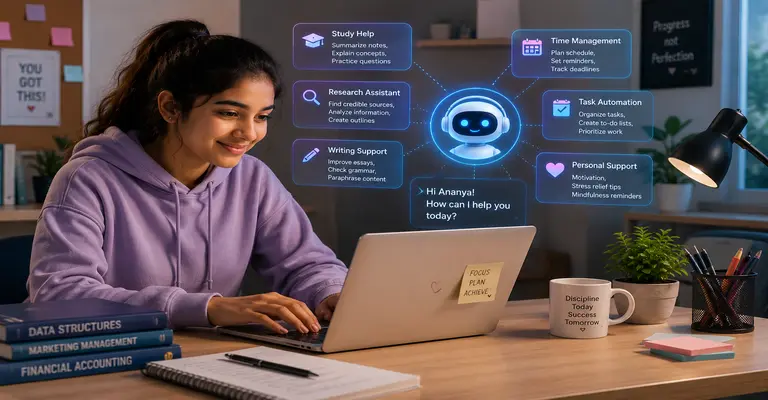
A Day in 2030 with an AI Assistant
It’s the year 2030, and AI assistants are no longer just apps on our phones—they’re constant companions woven into every part of life. Here’s how a typical day might look:
Morning: Smarter Starts
You wake up naturally as your AI assistant gently adjusts the smart blinds to let in sunlight. It noticed you stayed up late studying, so it let you sleep 20 minutes longer by automatically moving a morning meeting to the afternoon.
While you brush your teeth, it gives you a personalized morning brief: your class schedule, global news highlights, and a quick reminder that you’ve got an essay due in two days. Don’t worry—it’s already drafted a suggested outline for you.
Midday: Learning That Adapts to You
At university, your assistant sits quietly in the background. During a lecture, it transcribes notes in real time, highlights important points, and even suggests follow-up reading.
Later, as you review, it tailors practice quizzes based on what you struggled with. Forget rote memorization—learning in 2030 is about adaptive, AI-powered study sessions that help you actually master concepts.
Afternoon: Seamless Work + Collaboration
You work on a group project, but coordinating with classmates has never been easier. Your assistant syncs tasks between team members, translates comments from an international student into your native language, and even suggests design improvements for your presentation slides.
It’s like having a digital teammate, one who’s always organized, always on time, and always focused.
Evening: Personalized Well-Being
Back home, your AI notices your energy is dipping. It dims the lights, cues a calming playlist, and recommends a quick 10-minute stretch routine.
Dinner? Already handled. It ordered groceries earlier in the week based on your health goals and now guides you through cooking a nutritious meal in under 20 minutes.
Night: Reflection & Planning
Before bed, your AI assistant checks your sleep patterns, encourages you to wind down with a short guided meditation, and outlines tomorrow’s priorities.
Instead of a tool, it feels like a partner in your success—a blend of coach, mentor, and guardian of your well-being.
Looking Ahead
This glimpse of 2030 shows that AI assistants won’t just be about convenience—they’ll be about growth, balance, and empowerment. They’ll help us study smarter, work better, and live healthier.
The assistants of the future won’t just respond to commands; they’ll understand our goals, anticipate our needs, and walk alongside us as we create brighter futures.
The Future of AI Personal Assistants
AI personal assistants have evolved from simple voice tools into sophisticated digital companions capable of transforming how we work, learn, communicate, and manage everyday responsibilities.
The rise of AI agents marks the next chapter in this evolution. These systems are becoming more intelligent, more proactive, and more capable of handling complex tasks with minimal human input.
While challenges surrounding privacy, security, and ethical AI development remain important, the potential benefits are enormous.
As technology continues to advance, AI personal assistants will move beyond being useful tools and become indispensable partners in daily life.
The question is no longer whether AI will change how we live and work.
The real question is how quickly we will adapt to a future where intelligent AI assistants are woven into nearly every aspect of our lives.
Want to continue learning?
Register and get practical tutorials, tips, and real-world projects.
Register